I'm writing this on my way back from a trip to Rome. I mention this not to brag, but as a segue towards the point I wish to make.
The interesting thing about Rome (other than it's age) is that there are churches literally everywhere. Everywhere else I've visited there's a church for a different denomination no matter where you look. In the downtown of Rome, every church appears to be a 15th to 17th century baroque masterpiece. While I was there I must have visited over 17 churches and walked past three times more.
About 10 years ago I went on a trip with my friend Robert and his parents to London, England. I brought a digital camera on this trip and brought it along to the British Museum. I took so many photos that I somehow burned through the two AA batteries before we made it hafway through the museum. My attutude towards taking pictures on trips has changed since then due to the fact that these photos are basically meaningless to me. I know exactly where they are on my hard drive but those photos are just of stuff that just doesn't matter to me. Another concern is not wanting to look like a stupid tourist taking a picture of anything he sees. I have realized that photos of people doing things is more important—and makes a better and more useful photo—than just photos of things. I thought that in the 10 years since my London trip, i figured more people would come to the same conclusion as I had, but apparently not.
Rome being a city with more than a 2 thousand year history, there are many museums well. I only visited one museum on this trip, full of statues of early Roman Gods. A surprising amount of the Roman history that remains is that of the early Christians. Recall the face of Caesar mentioned on the money, and the voyages of Peter and Paul around Rome. The Holy Land of the Christians isn't in Israel or Palestine, it's in Rome where thousands of early Christians were martyred and persecuted for their faith.
In these old churches, there is a lot to see. Everywhere you look, there is detail. Elaborate patterns on the floor, decorative collumns, murals, paintings, inscriptions and altars. Because of this everyone wants to take pictures of everything. One church had a mirror placed just right so that you could get a perfect picture of the ceiling (they even had a line). The Basilica of St. Peter in Vatican City was very similar, with people taking pictures of things, but also using this incredible church as a mere backdrop for a vacation selfie where they are the centerpeice.
The point I intend to make (before I subvert it) is that in many ways these old churches have become museums. There are informational plaques beside many paintings and guided tours available, and of course people trying to sell things to tourists outside (that is if the church doesn't have a gift shop). Over dinner, my brother who invited me on this trip was musing about the arrogance of people to believe they could be more beautiful than the magnificient scupltures they pose in front of. Our tour of St Peter's Basilica was done by a priest. I was on the outside of the group for a time, not really paying attention. I overheard an old couple talking. The wife said "everyone's dressed the same as in the other museums we saw" and "it feels cold here, not like the church back home." I have to agree with this old lady and my brother. There is very little reverence.
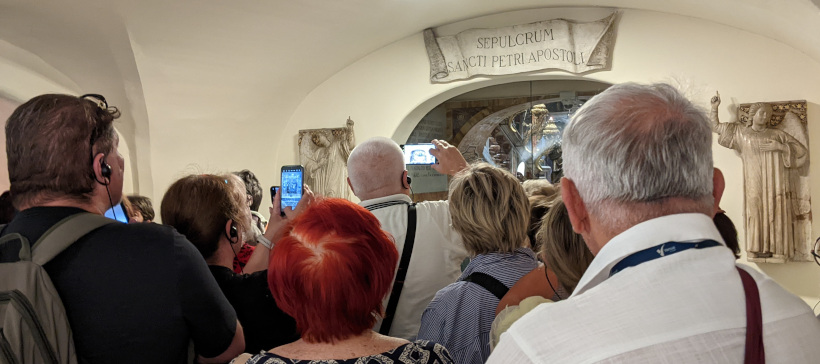
In this picture, obscured by the sea of people all trying to take a picture of St. Peter's Tomb are two of my friends, in front of the crowd, kneeling and praying. I wonder how many random tourists have the top of their heads in the photos they took. In some ways the few actual pilgrims are part of the exhibits. We all went to mass within St. Peter's one afternoon, and the whole time we were sitting, standing, and kneeling for the mass I knew there was a horde of people snapping photos of the altar and (though not the focal point) all the people present. Exiting the Vatican Necropolis (where many popes are buried) beneath the Basilica of St Peter, you pass a tunnel with a painting of St. Andrew's crucifiction. There was no plaque to tell us this, but me and two of my travel buddies got a good look at it enough to figure it out while we waited for others who were praying. The story goes that he wasn't worthy to be crucified like Jesus, or upside down like Peter. His cross was diagonal, an "X". While waiting, many people came up between us and snapped a quick photo before leaving up the stairs. There is no way they had the time to appreciate this painting and the depth of St Andrew's martyrdom.
Imagine an anternate world where to visit a church (even to use the bathroom), you had to pull out a copy of your Christianity license to prove you are allowed in. That would run contrary to the purpose of the church as a whole. Yes a church does exist nominally for worship. However, we need to not forget the words of the great commission, where one of Jesus's last instructions to us is to go and make disciples of all nations. For this reason, it's not our place to judge the people who are voluntarily visiting a church. The way people are choosing to experience this should be between them and God—not for us to judge. Most of the plaques accompanying interesting things in any of the churches or museums were in Italian and English. Considering the new pope I saw people of every language and part of the world. A bunch of Korean tourists are unlikely to speak fluent enough English to understand any plaques, perhaps they were using their phones to automatically translate the text in the photo. Waiting at the back with a view of St Peter's Tomb, I also saw a group of Bishops take a group photo there together. I wasn't judgemental of them for this—they are ordained bishops—so why should I judge a family or tourists? It is not our place to judge people who are excited to be visiting a religious inistitution, engaging in a mostly respectful way.
It it also important to consider the influence a church-museum has for attracting visitors. St Peter's, The Sistine Chapel, and the Colosseum are likely 3 of the top 5 things to see in Rome. Many people who were visiting may never have had an opportunity to enter a church before, and are only visiting because their algorithim told them to. The majesty of these building is a reflection of the devotion of the people of the church. The devotion of the early Christians in the face of persecution and up until the last few hundred years of globalization was presumably enough to fill this gargantuan basilica. The Church wants the pilgrims and tourists visiting to have the opporrtunity to be awestruck by the majesty of these places. I imagine that seeing the history and tradition of such a place may hopefully lead them to ask the question "If all the bible has to offer is 'just be a good person bro', then why was something like this ever constructed?"—"maybe there's more to this God thing." I have a friend who was recently baptised into the church, and I think this effect had something to do with it. He told me that he could always feel something about churches and never felt right swearing in them—even as an atheist. As frustrated as I was ducking around selfie sticks and camera FOV's, all I could really do was try to pray that something in the churches would stand out to the people who were annoying me.
Many times on this trip I was in church and the whole thing was in Italian. I went into this trip hoping that having taken French in school that I would be fine to understand enough Italian. This plan only worked a little; each time I would have to pull up the English mass readings so I could follow along. Without doing this, I could only understand occassional people and place names. I hope that the other parishioners were not judging me.
You don't have to travel to Europe to see the effect I'm talking about. The oldest churches in your region are probably seeing a similar fate. The oldest Catholic church in my home city now has a cafe in it's basement. Luckilly if you want to see these historical churches you don't need to splurge for a tour, you can just attend the regularly scheduled mass time and get arguably a more authentic experience. And while you visit, consider saying a prayer for the tourists who end up passing through those old, holy walls.